

If you’ve been searching for a new gaming desktop lately, you’ve probably noticed the same names keep coming up — iBuyPower, Skytech, Alienware, and a handful of others promising high performance right out of the box. Prebuilt gaming computers are everywhere, and for a lot of buyers, they seem like the obvious choice. Convenient, ready to ship, and easy to price compare.
But here’s the thing: not all gaming PCs are built the same, and in 2026, the gap between a prebuilt system and a properly specced custom gaming PC is more noticeable than ever. Before you make a decision you’ll be living with for the next four or five years, it’s worth understanding what you’re actually getting.
Why Prebuilt Gaming PCs Are So Popular
It’s easy to understand the appeal. You search “best gaming PC,” you see a list of systems with impressive-sounding specs, a price tag, and a buy button. No decisions to make, no waiting — it shows up at your door ready to go.
Prebuilt computers dominate search results for a reason: they’re heavily marketed, widely available, and they lower the barrier to entry for people who don’t want to think too hard about components. For casual use or entry-level gaming, some of them are perfectly fine.
The problem comes when buyers expect a prebuilt gaming desktop to perform and last the same way a thoughtfully built custom system would. That’s where the reality gap starts to show.
Where Prebuilt Gaming Computers Cut Corners
Prebuilt gaming PCs are built to hit a price point. That’s not a criticism — it’s just the economic reality of mass production. To sell a system at a competitive price, manufacturers make compromises. Those compromises tend to show up in places that aren’t obvious on a spec sheet.
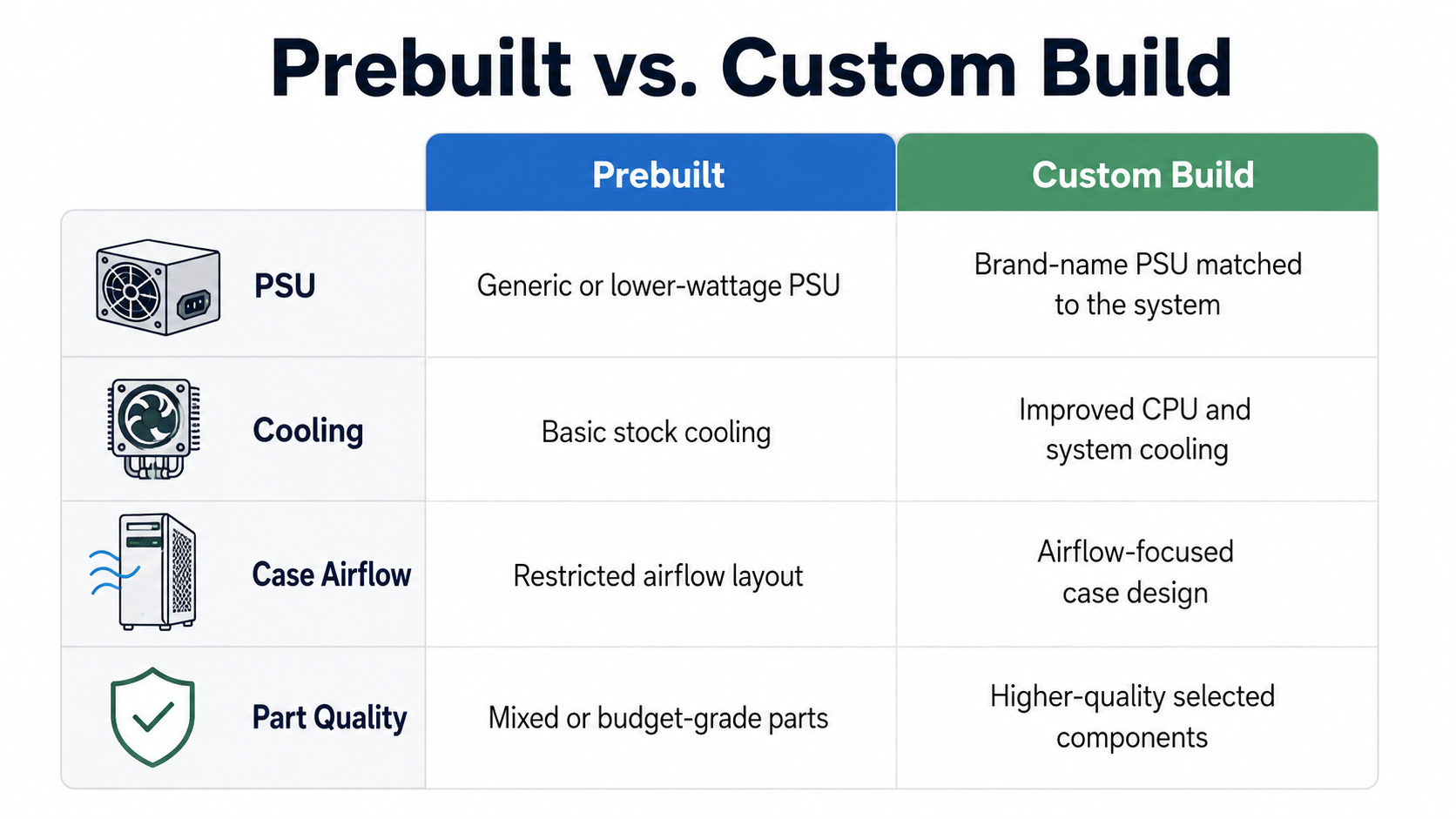
Power supplies are one of the most common areas. A generic or underpowered PSU can limit system stability, affect performance under load, and shorten the lifespan of the entire build. It’s also one of the first things that gets quietly downgraded in a budget system.
Cooling is another. Many prebuilt gaming desktops ship with stock coolers or low-quality fans that are adequate at launch but struggle as the system ages or when running demanding titles for extended sessions. You may not notice it immediately, but thermal performance matters a lot over a 3–5 year ownership window.
Case quality and airflow often get overlooked entirely. A case that looks great in a product photo doesn’t necessarily move air efficiently. Poor airflow means higher temperatures, louder fans, and more wear on components over time.
None of this is hidden. It’s just not something most product listings highlight.
What a Custom Gaming PC Actually Gets You
A custom gaming PC starts from a different place entirely. Instead of building to a price point, the goal is to build to a performance target — your resolution, your games, your preferences.
That means the CPU and GPU are chosen based on what you’re actually trying to do. In 2026, most serious gamers are targeting 1440p resolution, which is widely considered the sweet spot between visual quality and performance. Getting there smoothly requires a GPU tier that a mid-range prebuilt often can’t deliver consistently. Current options like the RX 9070 or RTX 5070 Ti represent a real generational step up from what ships in many prebuilt systems at similar price points.
Beyond the headline components, a custom build means:
- A power supply rated properly for the system it’s powering
- Cooling that matches the thermal demands of the hardware
- A case chosen for airflow and build quality, not just aesthetics
- An upgrade path that makes sense — so when you want to add RAM or swap a GPU in two years, the foundation is already there
It also means the person who built it knows exactly what’s inside and why.
The Brands You’ll See in Search Results
When you search for gaming computers for sale, you’ll run into the same brand names repeatedly. Some offer decent value at the entry level. Others are trading heavily on marketing while the actual hardware tells a different story.
Alienware has name recognition and backing from Dell, but the pricing often reflects the brand premium more than the components. iBuyPower and Skytech serve the budget-to-mid-range market and have their place, but both have well-documented issues with component quality at lower price points — particularly PSUs and cooling. These aren’t obscure complaints; they come up consistently in long-term owner reviews.
None of this means prebuilt is always the wrong choice. It means you should know what you’re comparing when you’re looking at price tags side by side.
How the Value Gap Looks at Different Budgets
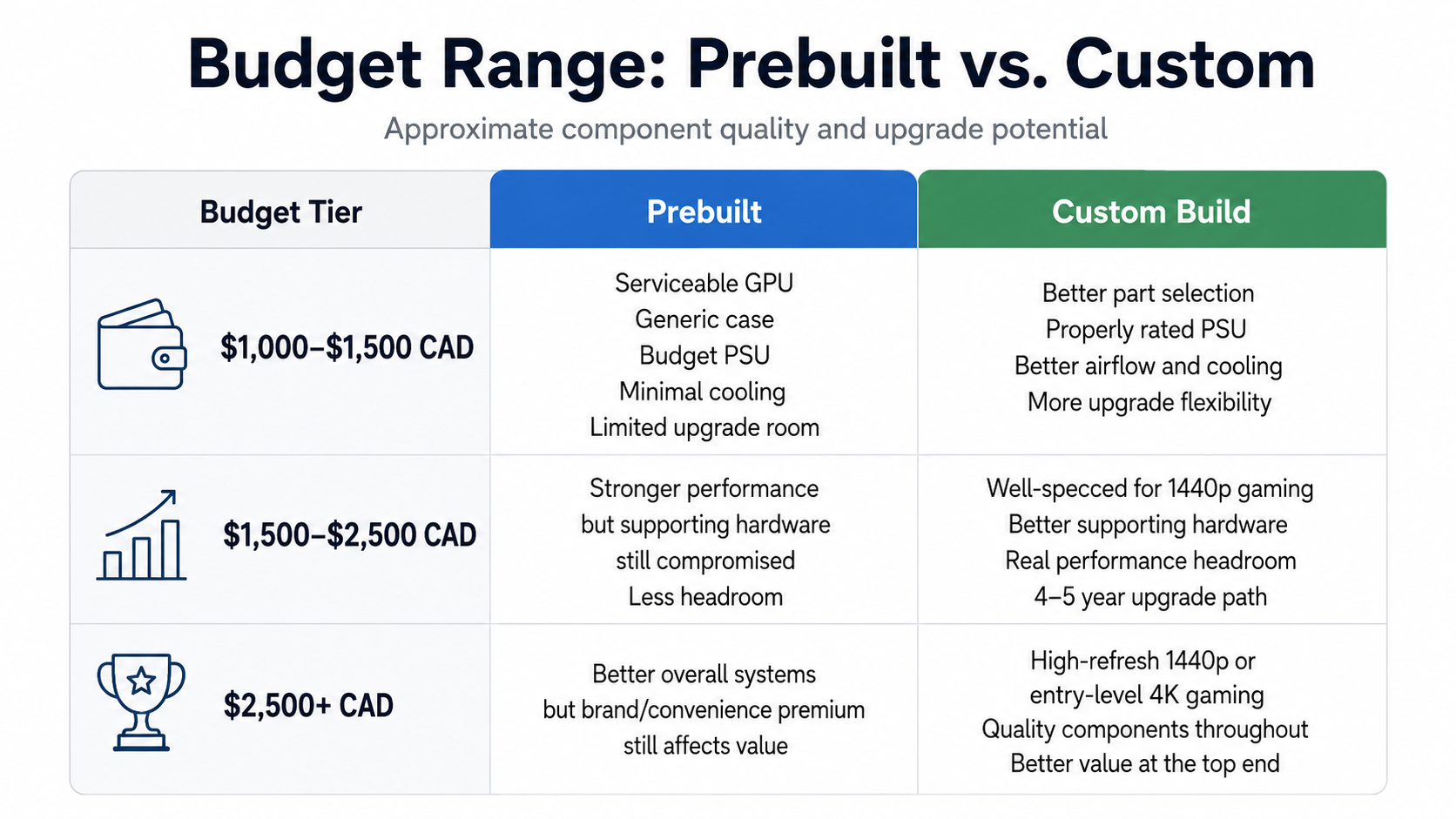
Here’s a general sense of how custom and prebuilt systems compare across budget tiers:
$1,000–$1,500 CAD Prebuilt at this range often gets you a serviceable GPU paired with a generic case, a budget PSU, and minimal cooling. It’ll run games, but you’re already at the ceiling of what the system can do. A custom build in the same range gets you better component selection, a properly rated PSU, and room to upgrade.
$1,500–$2,500 CAD This is where the gap widens. Prebuilts at this tier still make compromises on the supporting hardware to hit the price. A custom gaming PC here can be specced for 1440p gaming with real headroom and a legitimate 4–5 year upgrade path.
$2,500+ CAD At higher budgets, prebuilt options improve, but you’re still paying a premium for the brand and the convenience. A custom build at this level can deliver high-refresh 1440p or entry-level 4K gaming with quality components throughout — not just in the GPU.
Why a Local Custom PC Builder Is a Different Experience
There’s something that gets lost entirely in the prebuilt conversation: who do you call when something goes wrong?
With an online prebuilt order, you’re dealing with a warranty process, shipping, and a support line that may or may not be helpful. With a local custom PC builder, you have a direct relationship with the people who built your system. They know what’s inside it, they can diagnose problems quickly, and you’re not shipping your gaming desktop across the country and waiting three weeks to get it back.
For buyers in the Collingwood and Southern Georgian Bay area, that kind of support is genuinely hard to find elsewhere. It’s one of the quieter advantages of going custom with a local shop that doesn’t get talked about enough.
So Which Should You Choose?
If you want something inexpensive to get started with gaming and you’re not concerned about long-term performance, some prebuilt options at the entry level are reasonable. There’s no need to overcomplicate that decision.
But if you’re investing $1,500 or more in a gaming desktop — or if you want a system that will still feel capable in three or four years — a custom gaming PC built by someone who knows the hardware is almost always the better long-term investment. You get better components, better support, and a system that was actually designed around what you need.
Ready to Find the Right Gaming PC for You?
Not sure where to start? Contact us and we’ll help you figure out the right build for your budget and the games you play.
Want to learn more about what Mariner builds? Learn more about our custom gaming computers.