

Gaming PC hardware moves fast. Every year brings new GPU generations, faster processors, and a fresh wave of cases, cooling solutions, and accessories all competing for attention. It can be hard to know what’s actually worth paying attention to and what’s just noise.
2026 is an interesting moment in the gaming PC market because the trends shaping buyer decisions aren’t purely about raw performance anymore. The way people think about their gaming desktop — how it looks, how it sounds, how it fits into their home — has shifted meaningfully over the past few years. Some of that shift reflects genuinely better technology. Some of it reflects changing priorities among buyers. And some of it is marketing doing what marketing does.
Here’s an honest look at what’s actually driving the gaming PC conversation in 2026.
The Games People Are Playing Are Changing Hardware Expectations
Any conversation about gaming PC trends has to start with the games themselves, because hardware demand follows player behaviour.
In 2026, the titles with the largest active player bases are a mix of long-running competitive staples and newer releases that are pushing visual demands higher. Games like Counter-Strike 2, Rust, Apex Legends, and Dota 2 continue to drive massive ongoing hardware interest — these are titles where consistent high frame rates matter enormously and where players invest in their setups accordingly. At the same time, newer releases like Crimson Desert and Slay the Spire 2 are pulling significant attention and representing a different kind of hardware demand: richer environments, higher graphical fidelity, and sustained GPU workloads.
What this means for buyers is that a gaming desktop built in 2026 needs to handle both ends of that spectrum reasonably well — competitive performance at high frame rates and the visual demands of modern titles. A system that does only one of those things well is already showing its limitations.
Quiet Gaming PCs Are a Real Category Now
This is probably the most significant shift in buyer priorities over the last few years, and it doesn’t get enough coverage.
There’s a growing segment of gaming PC buyers — often people who have owned a gaming rig before — who are done tolerating loud systems. They want a gaming desktop that performs well without sounding like a server room. That’s a completely reasonable expectation, and in 2026 it’s more achievable than ever — but only if the build was designed with acoustics in mind from the start.
A quiet gaming PC isn’t about a single component. It’s the result of several decisions working together: quality fans from manufacturers like Noctua or Be Quiet, a case with proper airflow that doesn’t force fans to work harder than necessary, a CPU cooler matched to the thermal output of the processor, and sensible fan curve configuration. When those pieces are right, a high-performance gaming PC can run at load without dominating the room acoustically.
What doesn’t work is buying a loud, poorly cooled system and expecting an aftermarket fan or two to fix it. Quiet builds have to be designed that way — they can’t really be retrofitted.
The interest in quiet gaming PCs also connects to a broader shift in how people are using their spaces. Gaming setups are increasingly part of home offices and living rooms, not tucked away in a dedicated game room. A system that sounds reasonable in that context matters.
Water Cooling vs. Air Cooling: What’s Actually Worth It
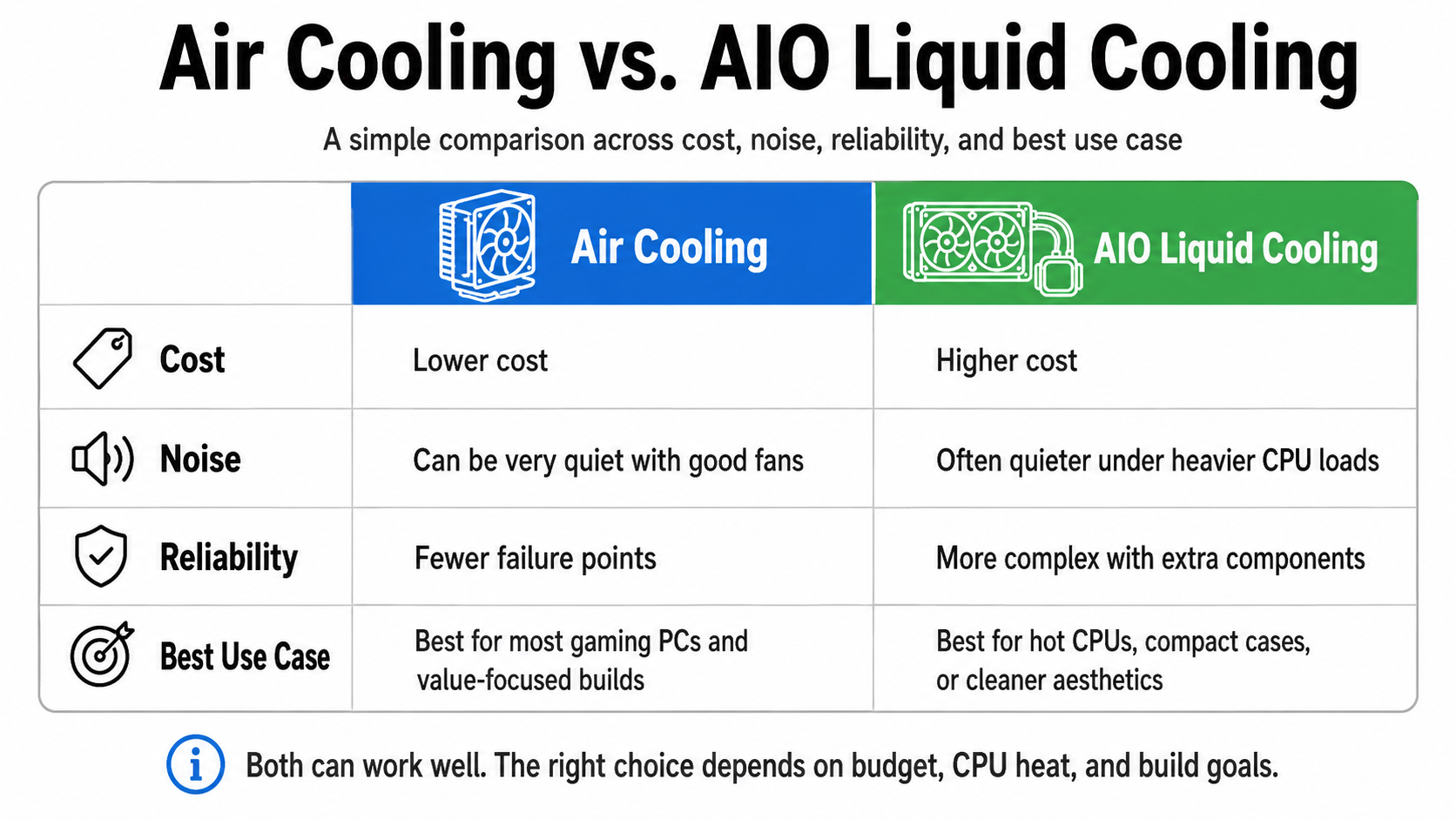
Liquid cooling has been a staple of enthusiast gaming PC builds for years, and it’s never been more accessible than it is now. All-in-one (AIO) liquid coolers are widely available, reasonably priced at the mid-range, and genuinely effective at keeping high-end CPUs at reasonable temperatures.
But liquid cooling isn’t automatically better than air cooling — and this is an area where marketing has done a lot of heavy lifting.
For the majority of gaming builds, a quality air cooler handles thermals perfectly well and does so quietly, reliably, and without the small but real risk of a coolant leak over a long ownership period. Premium air coolers from established manufacturers are consistently competitive with mid-range AIOs on noise and temperature performance, often at a lower cost.
Where liquid cooling genuinely earns its place is in high-end builds with top-tier CPUs generating significant heat, or in smaller form factor cases where a large air cooler physically won’t fit. In those situations, an AIO makes sense. For a well-specced mid-range gaming desktop, it’s often more of an aesthetic choice than a performance necessity.
Neither option is wrong. The right call depends on the specific build — which is exactly why it should be a considered decision, not a default.
Aesthetics Have Grown Up — And That’s a Good Thing
A few years ago, “gaming aesthetic” largely meant maximum RGB, aggressive angular designs, and cases that looked like they belonged in a sci-fi film. That look still exists and still has its audience, but the market has moved meaningfully toward something more considered.
White builds continue to be one of the most consistently requested aesthetics among gaming PC buyers. All-white cases, white GPU shrouds, white fans and cables — the clean, minimal look has real staying power and shows no signs of fading.
Clean, furniture-friendly cases have become a legitimate design category. Cases like the Fractal North — with its wood-accented front panel and understated profile — reflect a buyer who wants their gaming desktop to look intentional in a modern room, not like it’s trying to announce itself. This shift is real and it’s being driven by buyers, not manufacturers.
RGB has matured. The trend has moved away from every component lighting up independently in competing colours toward controlled, coordinated lighting that complements the build without overwhelming it. Tasteful RGB is still very much part of the 2026 gaming PC aesthetic — it’s just less chaotic than it used to be.
Aquarium and fish-tank style cases deserve an honest mention here because they generate a lot of interest and a lot of questions. These showcase builds look genuinely striking. They’re also thermally challenging, expensive to do properly, and not the right choice for a primary gaming system focused on performance and longevity. As a statement piece for someone who knows what they’re getting into, fine. As a first gaming desktop, there are better starting points.
The Gaming Setup Has Become Part of the Room
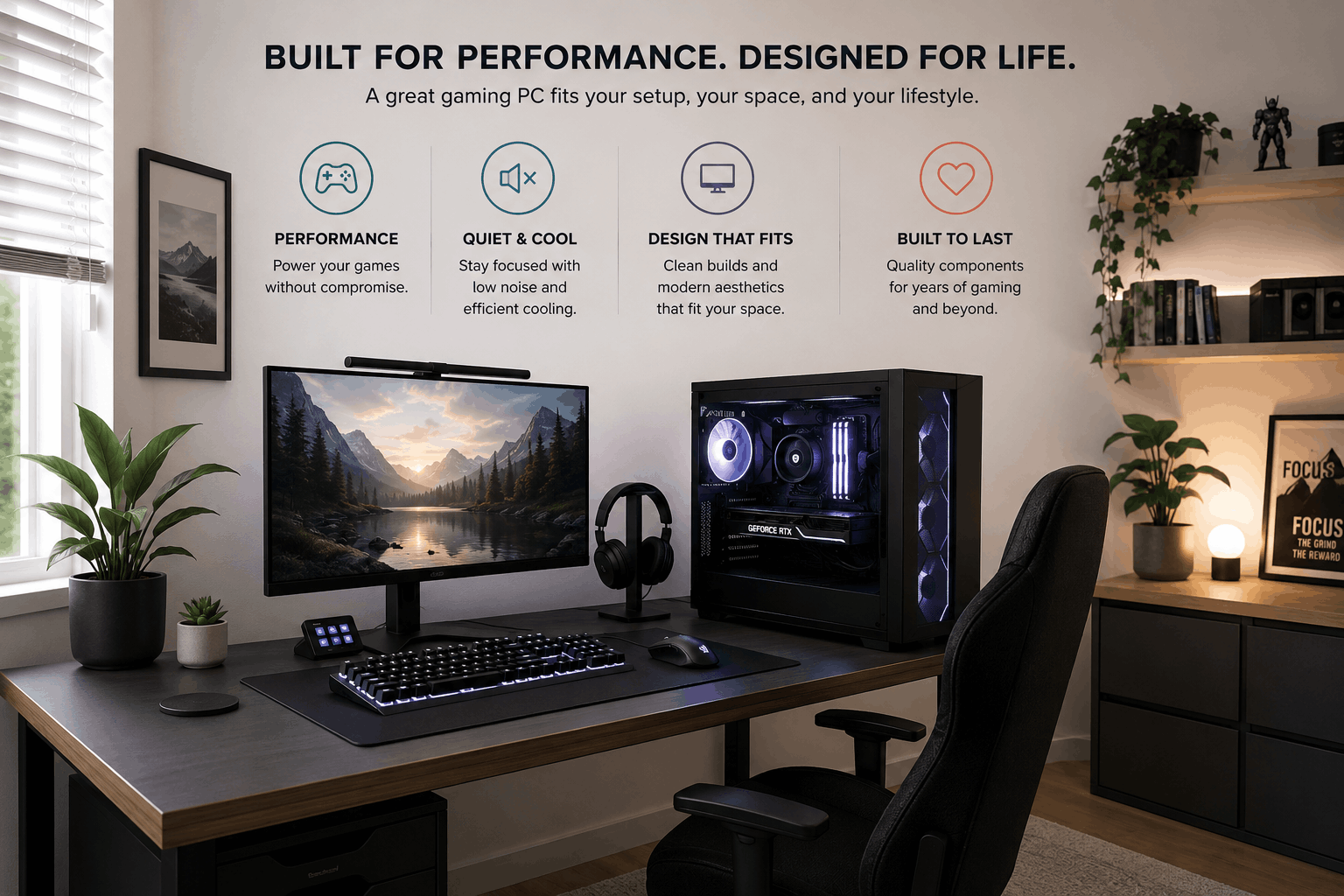
This one ties everything together. Gaming desktops have increasingly moved out of spare bedrooms and dedicated game rooms and into home offices, living spaces, and more visible parts of the home. That context changes what buyers are looking for.
A system that looks clean on a desk, runs quietly enough to not be distracting, and doesn’t require constant maintenance fits that environment. One that glows aggressively in seven colours, whines at load, and collects dust visibly through a smudged glass panel does not.
The best gaming PCs in 2026 reflect where buyers actually live and how they actually use their space. That’s not a soft consideration — it’s become a meaningful part of what a quality build looks like.
What’s Actually Worth Spending More On in 2026
With so many components, features, and options in play, it helps to know where additional budget actually makes a difference and where it doesn’t.
Worth spending more on: GPU tier, fan quality, case quality, and power supply. These are the components that have the most direct impact on long-term performance, noise, reliability, and the overall ownership experience.
Diminishing returns: Bleeding-edge CPUs beyond a certain tier, extreme overclocking hardware, and premium aesthetics features that don’t improve thermal or acoustic performance. These can make sense for specific use cases, but for most buyers they move the needle less than the fundamentals.
The common thread in quality builds is that the money goes where it actually improves the experience — not just where it looks impressive on a spec sheet.
Is Your Current Gaming PC Ready for 2026?
One trend worth acknowledging honestly: a lot of gaming desktops built four or five years ago are starting to show their age. Not because they stopped working, but because the gap between what they can do and what current games expect has quietly widened. Frame drops in newer titles, longer load times, thermal throttling under sustained load — these are signs that a system is approaching the end of its useful performance window.
Whether the right move is an upgrade or a fresh start depends on what’s inside the current system and what the upgrade path looks like. Sometimes a GPU or RAM upgrade buys another couple of years. Sometimes the platform is too far behind to make partial upgrades worthwhile.
Either way, it’s worth knowing where you stand before the frustration builds.
Thinking About Your Next Gaming PC?
Whether you’re upgrading an older system or starting from scratch, we’re happy to talk through what makes sense for your setup and budget. Get in touch with Mariner and let’s figure out the right path forward.
Want to see what a custom gaming desktop from Mariner looks like? Learn more about our custom gaming computers.