

Ask ten people what makes the best gaming PC and you’ll get ten different answers. A fast GPU. The latest CPU. Lots of RAM. A big SSD. And while none of those answers are wrong exactly, they’re all missing the bigger picture.
In 2026, the best gaming computers aren’t just the ones with the highest benchmark scores. They’re the ones that were built with a clear purpose, designed to last, and matched to the way the person using them actually games. That distinction matters a lot more than most buyers realize — and it’s the difference between a system you’re happy with four years from now and one you’re already frustrated with at the two-year mark.
So what actually goes into a great gaming PC in 2026? Let’s break it down.
There’s No Single “Best” — There Are Three Types of Gaming PC Buyers
One of the most useful things you can do before buying a gaming desktop is figure out which kind of buyer you are. In 2026, there are really three distinct mindsets driving the market.
Performance-first buyers want high frame rates, competitive responsiveness, and a system that keeps up with fast-paced titles like CS2, Apex Legends, and Rust. For these buyers, the GPU and CPU combination is the priority, and the build is optimized around hitting consistent high FPS at their target resolution.
Aesthetic-first buyers care about how the system looks as much as how it performs. Clean desk setups, white builds, controlled RGB lighting, and glass-panel cases are all part of the picture. For this group, a gaming PC is also a visual part of the room — and there’s nothing wrong with wanting both.
Mature and practical buyers have often owned a gaming PC before and know what bothered them about it. They want something fast and capable, but they also want it to be quiet, run cool, and not require constant attention. This is a growing segment of the market, and it’s pushing real change in how quality builds are specced.
Understanding which category you fall into changes almost every component decision in a build.
What Games Are Actually Driving Hardware Demand Right Now
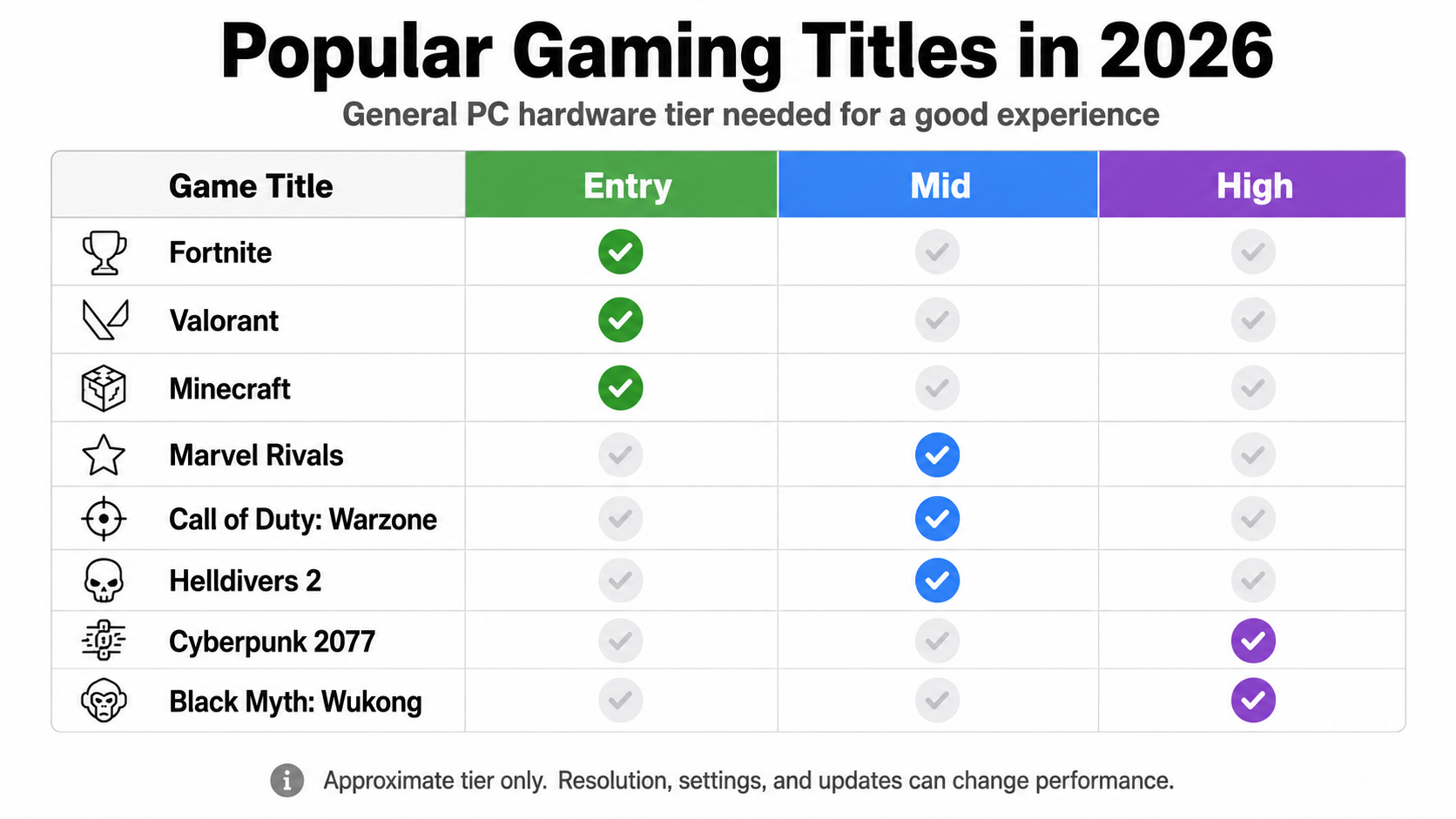
Hardware requirements don’t exist in a vacuum — they’re shaped by what people are playing. In 2026, the titles putting the most consistent pressure on gaming hardware include long-running competitive staples like Counter-Strike 2, Apex Legends, Rust, and Dota 2, alongside newer releases like Crimson Desert that are pushing visual fidelity and system demands higher.
What this means practically is that a gaming desktop built around the titles dominating player charts right now needs to handle both sustained workloads for open-world and graphically intensive games and the high frame rate demands of competitive multiplayer. A system that does both well isn’t an accident — it’s the result of balanced component selection.
The CPU and GPU Conversation, Without the Jargon
Most gaming PC research eventually ends up in a deep dive on CPUs and GPUs, and it can get overwhelming fast. Here’s the practical version.
For gaming in 2026, the CPU choice matters — but it’s not where most of the performance difference lives for the majority of players. A well-chosen current-generation processor like AMD’s Ryzen 7 9800X3D handles the demands of virtually every current title without becoming a bottleneck. The bigger decision for most buyers is the GPU tier.
Current GPU options span a wide range. Cards like the RX 9060 XT and RX 9070 represent strong value at the mid-to-upper tier, while the RTX 5070 Ti and RTX 5090 sit at the high end for buyers who want headroom at 1440p or are targeting 4K. The right choice depends entirely on your resolution target and budget — not on chasing the highest model number available.
The key point: in a well-built gaming PC, the CPU and GPU should be matched to each other and to the resolution you’re actually gaming at. A mismatched build — powerful GPU in a system with an aging or underpowered CPU, or vice versa — doesn’t deliver what either component is capable of.
Why 1440p Is the Sweet Spot for Most Gamers
Resolution is one of the most important decisions in speccing a gaming PC, and in 2026 the conversation has largely settled around 1440p as the target for serious gaming.
1080p is well-supported and still perfectly playable, but it’s no longer the standard for a premium gaming experience. 4K is visually impressive but demands significantly more from the GPU, and the performance trade-offs at that resolution still aren’t worth it for many buyers outside of specific use cases.
1440p hits the balance: noticeably sharper than 1080p, less demanding than 4K, and well-supported by current mid-to-high tier GPUs. If you’re investing in a quality gaming desktop in 2026 and you plan to use it for the next several years, 1440p is almost certainly the right target to build around.
The Parts Nobody Talks About — That Matter More Than You’d Think
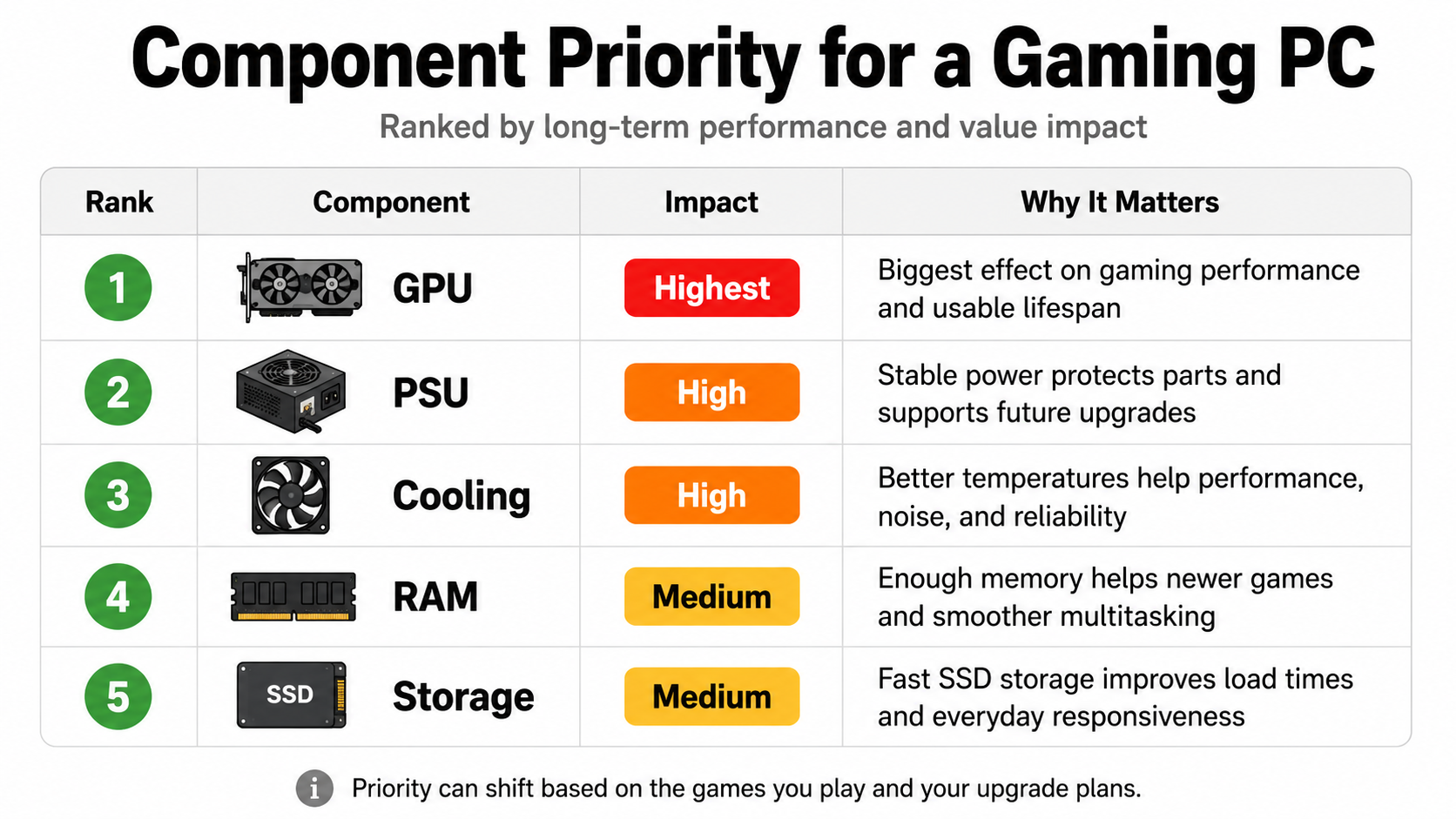
GPU and CPU headlines get the attention, but some of the most important decisions in a quality gaming build come down to components that rarely show up in marketing materials.
RAM — 16GB is the current practical minimum for gaming in 2026, and 32GB is increasingly the right call for anyone running demanding titles alongside background applications. Speed and configuration matter too; a single stick instead of a matched pair is a surprisingly common bottleneck in budget and prebuilt systems.
Storage — A modern NVMe SSD isn’t optional anymore. Load times, game streaming from storage, and overall system responsiveness are all meaningfully better with current-gen SSD options compared to older SATA drives or spinning hard disks. Many players run a fast NVMe for their OS and active games, with secondary storage for everything else.
Power supply — Possibly the most undervalued component in a gaming PC. A quality PSU from a reputable tier protects every other component in the system and is a direct contributor to long-term stability and lifespan. It’s also one of the first places corners get cut in budget and prebuilt builds.
Cooling — Good thermals aren’t just about preventing overheating. A well-cooled system runs more consistently, sustains performance under extended load, and produces less noise. Fan quality, cooler choice, and case airflow all feed into this — and the difference between a system that runs quietly at load and one that sounds like it’s about to take off is almost entirely a build quality decision.
Case Quality and Airflow: Why the Box Matters
The case is easy to think of as a cosmetic decision, but it’s actually one of the more consequential choices in a gaming build. A well-designed case with good airflow keeps temperatures lower, reduces fan noise, supports better cable management, and often looks better in a room than cheaper alternatives.
In 2026, the case design conversation has shifted away from “maximum glass and RGB” toward a balance of aesthetics and thermal performance. Cases like the Fractal North have resonated with buyers precisely because they manage to look clean and furniture-friendly while still moving air properly. That’s not a coincidence — it reflects where buyer priorities have actually landed.
A good gaming desktop should fit your space as much as it fits your desk.
Good Gaming Computers Are About the Whole System
The best gaming PC in 2026 isn’t a single component. It’s a system where every part was chosen with intention — where the GPU and CPU are matched, the cooling is appropriate for the thermal load, the PSU is rated properly, and the case supports the airflow the build needs.
That kind of coherence is hard to find in a mass-produced prebuilt. It’s what a custom gaming PC is actually built around.
Want Help Speccing the Right System?
Every buyer’s ideal gaming PC looks a little different. Get in touch and we’ll help you figure out exactly what your build should look like.
Not sure what Mariner offers? Learn more about our custom gaming computers and what goes into every build.